

公告
- Hello, welcome to my page!
你好,欢迎你来我的首页!
BLOG
-
Chinese Money | 中国的人民币
2011-04-17 5:27AM / 標準BLOG / 會員可以看
2個評論This is an article I found, and thought it was really interesting so I'm sharing it. I've been to most these places, but there are still a two I haven't been to: 5 and 50.
.jpg)
1) One Yuan—West Lake, Zhejiang
Don't let the low denomination fool you. Just because the one Yuan note isn't worth much, scenic West Lake pulls in thousands of tourists each year. This 15-km circumference lake takes its name from classical-era poems written about its beauty, making it famous even when Marco Polo visited. Present-day visitors can take their picture at the stone pagodas poking out of the water at Three Ponds Mirroring the Moon, just like you see it on the one Yuan note.How to find it: Hangzhou, Zhejiang Province.
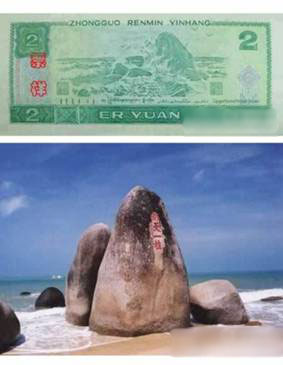
2) Two Yuan-- The End of the World, Hainan
To find the image from the two Yuan note in real-life, grab your swimwear and head far south to the edge of China. Long before bronzed foreigners and groups of same-hat-wearing tourists descended upon Hainan Island, it was the site of forced vacations for out-of-favour politicians. Exiled diplomats felt that a sunny, white beach at the southernmost tip of the island was the end of the civilized world and they carved their musings in calligraphy on great boulders near the sea. These stony poems have been immortalized on the two-yuan note.How to find it: Tianya Haijiao Park, Tianya town, Hainan.
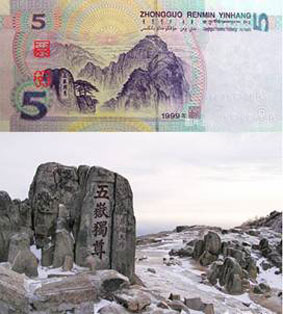
3) Five Yuan—Mount Tai, Taoist Holy Peak, Shandong
Going back north, the five Yuan note commemorates China's foremost Taoist holy mountain. Considered formed from creator of the world Pangu's head, many embark on a pilgrimage to Tai Shan praying for rebirth or renewal. In the 1980s, the 1,500-meter plus tall mountain was named a UNESCO World Heritage Site. Visitors to Tai Shan can climb its forested slopes via pathways of more than 7,000 steps or use buses and cable cars to reach the summit. Unfortunately however, tourists won't be able to get the exact view depicted on the note from the mountain itself.How to find it: South of Jinan, the capital of Shandong Province.
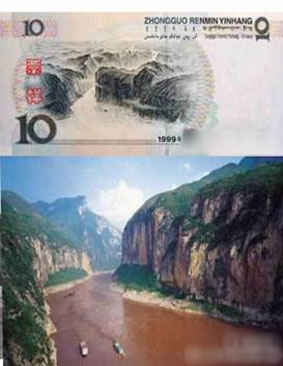
4) Ten Yuan—The Three Gorges, Chongqing
On to central China next. The famous Three Gorges of the Yangtze River are emblazoned in blue on the ten Yuan note. Although some people have only heard of them in reference to the Three Gorges Dam downstream, these tawny cliffs carved by the water of one of the world's most important rivers have been attracting river-going travelers since the Song Dynasty.How to find it: The gorges take up about 120 kilometers between Fengjie, Chongqing and Yichang, Hubei. River trips depart daily from both up- and down-stream.
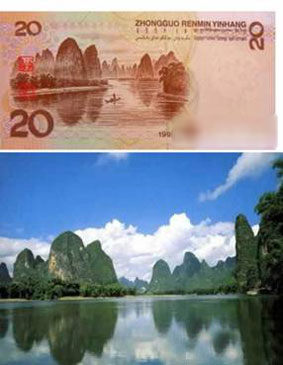
5) Twenty Yuan—Lijiang River, Guangxi
Another river scene decorates the 20 Yuan note. The distinctive mountain-water vistas of the karst formations near tourist Mecca Yangshuo have inspired painters and poets for centuries. The placid Li River winds along between the knobbly hills like thread between bobbins. Despite the large influx of tourists, fishermen still take their boats out on the mirrored waters and use hook and line or even a live cormorant to get their day's catch.How to find it: Xingping Village, Yangshuo, Guangxi province.
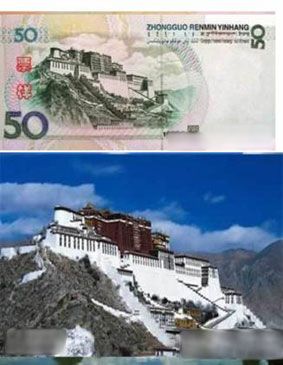
6) Fifty Yuan—Potala Palace, Tibet
Going still farther west, we find the 50 Yuan note in Tibet. Once the home of lamas and now a museum, the Potala Palace's staircases wind their way up the obverse of the 50 Yuan note. A UNESCO World Heritage site, Potala Palace is a place of pilgrimage for many Buddhists and is the iconic building of Lhasa.How to find it: Lhasa, Tibet.
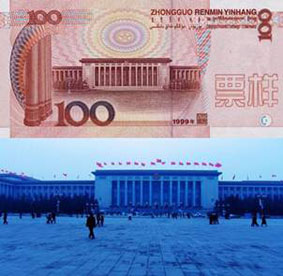
7) One Hundred Yuan—The Great Hall of the People, Beijing
China's largest denomination note of course features the capital. The Great Hall of the People was finished in 1959 and is home to the National People's Congress. Built to commemorate the first 10 years of the People's Republic of China, within its halls you can do another virtual tour of China, stopping by rooms decorated in signature fashion of Guangdong, Sichuan and so on.How to find it: Tiananmen Square, Beijing
8) The Jiao—Minority Groups
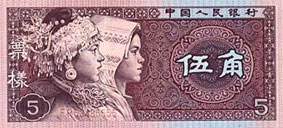
-The five Jiao, or 0.50 RMB, note features the faces of one Miao and one Zhuang woman in full cultural dress. Miao and Zhuang minority people are generally found in southern China, specifically Guangxi and Guizhou provinces.
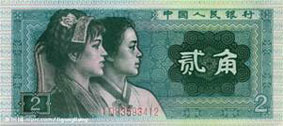
- The two Jiao, or 0.02 RMB, note features a woman each from the Bouyei and Korean minorities. Bouyei people live mostly in Guizhou and Yunnan, while the Korean minority lives near the North Korean border.
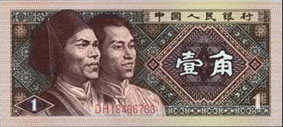
- Finally, the one Jiao, or 0.10 RMB note features two men, one from the Gaoshan group and one Manchu. The Gaoshan people are native to Taiwan, while the Manchus were historically living in northeastern China.
所有BLOG 更多BLOG >
-
Tongli
2012-05-17 1:59PM (2 個評論)
-
May day, May day
2012-05-07 6:17PM
-
Sanya
2012-04-06 10:14AM (3 個評論)
-
Hong Kong
2011-09-22 4:28AM
-
Almost there!
2011-03-15 12:11PM

统计信息
- Hello! Here is a little about me:...Hello! Here is a little about me:
I'm originally from America nearby Boston, but I live and work in China. I am a veteran of the US Navy and an alumnus from the University of Virginia.
In the past, I've often traveled to China and visited different cities, experienced the culture, and practiced the language. I've lived in Beijing for about 24 months spread out over the past six years, and now work in Shanghai. I've traveled all over the country, and been to more than 40 different cities. I've also traveled all over the rest of the world; Asia, North America, Europe and the Middle-East. Of all the places I've been, Beijing is definitely my most favorite. There is always something to do no matter what time of the day or day of the week it is. After Beijing, I like Chongqing, Sanya, and all of Yunnan province.
Some hobbies I enjoy in my free time include playing tennis, rock climbing, snowboarding, swimming, American football, basketball, badminton, ping pong, soccer, and pretty much every other sport you can think of. I've recently become interested in golf, and would love to meet people to play with.
I also really really love movies; I love both Chinese and Western movies. Everything from action to horror and even some romantic comedies. This deep appreciation for films is what brought me to Alive not Dead in the first place.I also like Japanese animation like Naruto, Dragonball Z, and Bleach.
My favorite foods in China are Beijing kaoya, hot pot, jiaozi, zhajiang mian, yuxiang qiezi, mapo doufu, gongbao jiding, yangrou chuanr and ma la tang. I really like spicy food!
For music, I like rock and hip hop. Some favorite bands I like are Green Day, Led Zeppelin, All-American Rejects, Blink 182, Jay Chou, Linkin Park, Wang Leehom, Guns N' Roses, Eminem, CCR, Fall Out Boy, Kanye West and a ton of others. I also listen to a lot of classical music, especially while working. I love piano and violin music the best. My favorite violinist are Nicolo Paganini and Antonio Vivaldi. Also, I love Pachelbel's Canon (Canon in D major) and Piano Sonata No. 14 in C sharp minor by Beethoven.
Anything else you want to know just ask! Thanks for reading.
(I wrote this Chinese part a few years ago, but I'm too lazy to update it.)
我是在福吉尼亚大学的学生,专业是东亚研究。我学习了大概四年的中文,还有每年夏天我去中国过假期。我去中国所以我可以练习说中文,还有旅游。我很喜欢中国的文化,历史,食物,古代建筑,语言,风景和中国人。
我的爱好是打乒乓球,打网球,游泳,攀岩和看书。我最喜欢看电影。美国的、亚洲的我都喜欢。 - 年齡: 44
- 性別: 男
- 查看: 148,765
RSS訂閱


獎牌
-
 2009年9月1日
 -
 2009年8月1日
 -
 2009年7月6日
 -
 2009年6月2日
 -
 2009年4月30日
 -
 2009年4月1日
 -
 2009年3月17日
BLOG評論 (2)